Skip to the playbook

For event promoters running Meta ads

Plan your event's Meta ads from 100 real campaigns.

A PDF playbook, three pacing plans, a spreadsheet of every case and an AI skill that interviews you about your event, then plans your whole campaign.

£37 one-off

  • Instant download
  • Free sample chapter to check fit
  • Secure card checkout by Stripe
  • PDF guide
  • 3 pacing playbooks
  • What went wrong
  • AI planner skill
  • CSV case library
  • 100 real event ad programmes, anonymised and written up one by one
  • 3,192 campaigns analysed for the benchmarks
  • 28 ad accounts behind the numbers
  • £2.6M of Meta spend analysed over twelve months
  • 3 pacing playbooks, with the cases behind each one
  • 300 pages of method and case studies
  • Free sample chapter to check fit first

The problem

Most event ad budgets are spent on a guess.

You know you need Meta ads. What is harder to know is how much to spend, when, and on what.

  1. Pacing is decided on instinct.

    Do you pump the budget at on-sale, spend half up front, or start small and spend later? Most promoters pick one by feel and only find out at the end whether it was the right call.

  2. Generic ad advice doesn't fit a ticket.

    Events have a date, a capacity and a presale window. Advice written for online shops ignores all three.

  3. You only ever see your own campaigns.

    One account can't tell you what normal looks like. A hundred campaigns, side by side, can.

  4. The weak campaigns never get written up.

    People share their wins. This playbook also covers what went wrong in the weakest campaigns, so you can skip paying for the same lessons.

What you get

Five things, one download.

Read it, filter it, or hand it to your AI assistant. Everything comes from the same 100-campaign library.

01 PDF guide

The method, and how to copy it

A detailed guide to how the 100 campaigns were structured, paced and run, written so you can replicate the approach for your own event. Each case study sets out the same twelve details.

  • Event type
  • Market
  • Banded budget
  • Pacing style
  • Campaign structure
  • Audiences
  • Placements
  • Creative formats
  • CTAs
  • Templated captions
  • Duration
  • Indexed result
02 Three playbooks

Three ways to pace the budget

Presale-led, spend half up front, or a small on-sale with most of the budget later. Each one is explained step by step, with the cases behind it.

  • A. Presale-led
    Presale-led: the biggest share of spend in the first tenth of the run while registration is open, then lower, steadier spend through the sale
  • B. Spend half up front
    Half up front: spend peaks in the first three tenths of the run, then tapers to the event
  • C. Small on-sale, spend later
    Small on-sale, spend later: light spend for most of the run, then the biggest share in the final tenth
03 Candid chapter

What went wrong

A full chapter on the weakest campaigns in the library: what was tried, where it fell short and what to avoid.

04 AI skill, one zip

meta-ads-event-planner

Load it into your AI assistant, with a step by step install guide. It interviews you about your event, then plans your whole Meta campaign from the 100-case library: budget, pacing, audiences, placements, creatives and schedule.

meta-ads-event-planner.zip

  1. 1Interview
  2. 2Match to cases
  3. 3Plan
05 CSV

The case library, as a spreadsheet

Every anonymised case in one file you can sort and filter, so you can pull up the campaigns that look most like your event.

Inside the playbook

Inside the guide.

Twenty chapters in five parts, one page for each of the 100 cases, and a set of appendices you can print.

  1. Where the numbers come from, how to read them, and the twelve findings that matter most. Every result is indexed to that account's own baseline.

    • The evidence base and how to read the numbers
    • Twelve findings, each with how strong the evidence is
    • What Meta-attributed results can and can't tell you
    • How the cases were chosen and anonymised
  2. Objectives, audiences, placements, formats, creative and copy, as they appear in real event campaigns.

    • Campaign and ad set architecture, with blueprints by event size
    • Audience stacks, from cold to retargeting
    • Placements and creative formats
    • Captions and call-to-action buttons
  3. Lead time, run length, budgets, and the three pacing playbooks: presale-led, half up front, and a small start with a big finish.

    • The event timeline: when to start and how long to run
    • Budgets by event size
    • Playbook 1: presale-led. Playbook 2: half up front. Playbook 3: small start, big finish
    • How to choose between the three
  4. One page per anonymised campaign programme, plus the weakest cases and what went wrong.

    • The case library at a glance
    • Cases C001 to C100, one page each, with the same details on every page
    • What went wrong: the weakest cases, their patterns and warning signs
  5. Measurement, build checklists, a weekly routine, how to repeat this analysis on your own account, and the AI skill.

    • Measurement you can trust
    • Build checklist, the first 72 hours and the weekly routine
    • Replicate this analysis on your own account
    • What Meta changed in 2026, and what it means for event ads
    • Plan your campaign with the AI skill
  6. Glossary, definitions, the case data dictionary, benchmark tables, printable checklists, a swipe file and sources.

    • Printable checklists
    • Swipe file: caption structures, naming conventions and templates
    • Benchmark tables and the data dictionary for the CSV
    • Sources and further reading

A case study, laid out

Every case follows the same layout.

Each of the 100 cases records the same details, so you can compare like with like and lift what is useful.

  • Find the cases that look most like your event.
  • See how they were structured, paced and run.
  • Copy the structure and adapt the captions.

Results are Meta-attributed and blended across channels. Real ticket sales are always higher than what Meta attributes.

Playbook page Case study template
Event type
club night | venue | arena | theatre | concert | comedy | family | festival
Market
UK | EU | US | AU
Banded budget
£ band, not the exact spend
Pacing style
presale-led | half up front | small on-sale, spend later
Campaign structure
campaigns and ad sets
Audiences
audience types used
Placements
where the ads ran
Creative formats
video | static | carousel
CTA
button label
Templated caption
caption you can adapt
Duration
weeks

Meta-attributed result

indexed to this account's own baseline
A blank layout to show how each case is set out. It contains no real data. The real cases are in the guide and the CSV.
Three pacing playbooks

When you spend matters as much as how much.

The library covers five pacing styles. Three get a full playbook each, with the cases behind them. The other two, steady drip and single flight, are compared in the guide so you know when they fit.

  1. Pump the budget

    Presale-led

    Spend hard first to build a registration list, then sell tickets to that list when the on-sale opens.

    Trade-off Less is left once the sale is open, and Meta only sees part of what a presale list goes on to buy.

    Presale-led: the biggest share of spend in the first tenth of the run while registration is open, then lower, steadier spend through the saleRegistration opensEventOn-sale
  2. Half up front

    Spend half up front

    Front-load the budget: test early, then put the money behind what sold. The typical run had spent most of its budget by halfway.

    Trade-off Less is left for late demand, and some runs stop spending before the event.

    Half up front: spend peaks in the first three tenths of the run, then tapers to the eventOn-saleEvent
  3. Spend later

    Small on-sale, spend later

    Spend a small amount around on-sale and keep most of the budget for later in the campaign, towards the event.

    Trade-off You give up early push, and rely on demand holding up.

    Small on-sale, spend later: light spend for most of the run, then the biggest share in the final tenthOn-saleEvent

Median shape of each style in E Labs programme data: share of spend in each tenth of the run (21 presale-led, 33 half up front and 128 small start programmes). Not a forecast.

The AI skill

It interviews you, then plans the campaign.

meta-ads-event-planner is a skill for your AI assistant. It asks about your event in short batches, picks a pacing shape, builds a budget calendar that adds up, finds the closest cases in the 100-case library and writes the plan.

  • Asks a few questions at a time, with a default for each, then reads your answers back
  • Picks a pacing shape, names the runner-up and says how sure it is
  • Builds a day-by-day budget calendar that adds up to your budget
  • Finds the closest cases, and the closest strong ones, and what to copy or question
  • Lists every assumption, so nothing looks more certain than it is

meta-ads-event-planner.zip

Worked example, shortened
  1. meta-ads-event-planner

    I will ask in short batches and suggest a default for each question, so you can say "I don't know yet" and carry on. What kind of event is it, how many people can it hold, and when is it?

  2. You

    A club show with a headline DJ and two support acts. 2,000 capacity. Friday 11 December, UK.

  3. meta-ads-event-planner

    Tickets next. What are the tiers and prices, when do they go on sale, and is there a presale or registration stage?

  4. You

    Early £25 (500), General £30 (1,200), Final £35 (300), all-in. On sale 16 October, the day the ads start. No presale, we couldn't get a page ready in time.

  5. meta-ads-event-planner

    And the money: what is your total Meta budget, and what have tickets cost you through Meta before?

  6. You

    £6,500. Between £11 and £14 in Ads Manager, though I never checked the attribution setting.

  7. meta-ads-event-planner

    Here is what I heard: 2,000 people, 11 December, three tiers averaging £29.50, on sale 16 October, no presale, £6,500 at £12 a ticket. I am assuming the Conversions API is not confirmed yet. Is that right? Then I will plan it.

Your campaign plan Club show, 2,000 capacity, £6,500 over 57 days
ShapeHalf up front (spend half early). Steady drip is the runner-up, and it is a close call: one point apart.
MoneyCold prospecting 67% (£4,353) and warm retargeting 33% (£2,147). The biggest single day is 2.9% of the budget.
At your assumptionsAbout 542 Meta-attributed ticket purchases (27% of capacity) at £12 each. Real sales will be higher. This is not a forecast.
EvidenceHalf up front scored a median of 1.14 against each account's own norm, across 33 programmes in 11 ad accounts. Promising, not proven.
RisksThe Conversions API is unconfirmed, about a third of the budget is spent by 29 October, and December costs tend to be higher.
First actionsAsk the ticketing platform to confirm the Conversions API and run a test order. Build the warm audience. Brief the designer.

A shortened run of a worked example in the download, for an invented event. The pick and the budget split come from the skill's own scripts. All figures are Meta-attributed, so real sales will be higher, and none of it is a forecast.

Is it for you?

Built for promoters. Honest about the limits.

It's for you if

  • You promote ticketed events and run, or plan to run, your own Meta ads.
  • You promote club nights, venues, shows, concerts, comedy, family events or festivals.
  • You would rather start from structures used on real campaigns than from a blank page.
  • You want to decide pacing and budget from evidence, not instinct.

It's not for you if

  • You want a guarantee of sales. No playbook can promise that.
  • You want someone to run the ads for you. This is a guide, not a service.
  • You want a click-by-click Ads Manager tutorial. The playbook shows what to build and why.
  • You've never opened Ads Manager and need the basics first.

Read this before you buy

What the results do and do not tell you.

Results shown in the playbook are Meta-attributed and blended across channels. Real ticket sales are always higher than what Meta attributes.

  • Meta-attributed.

    Every result is what Meta credited to the campaign. It's a useful guide, not a full count of tickets.

  • Blended across channels.

    Ads, email, organic posts and word of mouth all work at the same time, so a result is not a clean read of one ad.

  • Indexed to each account.

    Each result is shown against that account's own baseline, so you compare like with like. It's not a promise of what you'll get.

  • Not a guarantee.

    The library is the best way E Labs has found to structure event campaigns. Your event, audience, price and creative still matter.

Pricing

One price. Everything included.

Pay once and download everything straight away. No subscription.

  • The PDF guide
  • Three pacing playbooks
  • The what-went-wrong chapter
  • The meta-ads-event-planner AI skill, with an install guide
  • The CSV case library

The Event Meta Ads Playbook

£37 One-off payment

Instant download PDF, ZIP and CSV

All sales are final

You get the files straight away, so there are no refunds or cancellations once the download starts. Check fit with the free sample chapter first. Your legal rights for faulty or misdescribed digital content are not affected. The refunds and cancellation policy has the details.

Elliot Matthews, founder of E Labs, smiling in a studio portrait
Elliot Matthews Founder & Director, E Labs

Who made this

Made by a promoter who's in the ad accounts.

Elliot Matthews is the founder of E Labs, a London event marketing agency. He has spent more than a decade promoting live events, from club nights to festivals.

The Event Meta Ads Playbook turns the patterns in 100 real campaigns into a structure you can copy and adapt, so you spend less time guessing and more time selling tickets.

In live event promotion
10+ Years
Events engineered
1,000+

Questions

Before you buy.

Something missing? Email us and we'll answer it properly. elliot@e-labs.agency

A detailed PDF guide to the method, three pacing playbooks, a chapter on what went wrong in the weakest campaigns, an AI skill called meta-ads-event-planner (one zip, with a step by step install guide) and a spreadsheet of the 100 anonymised cases. You can download everything straight after payment.

Yes. Each case is one event's whole Meta ad programme, with every campaign and ad set it ran, from real ad accounts: club nights and venue programmes, arena and theatre shows, concerts, comedy, family events and festivals. Every one is anonymised, so you won't find event, venue, artist or ad account names in the playbook or the CSV.

The benchmarks in the playbook come from a wider pool: 3,192 campaigns from 28 ad accounts, so you can see what is typical as well as what is possible.

Results shown in the playbook are Meta-attributed and blended across channels, so they are a guide rather than a clean read of what one ad did. Real ticket sales are always higher than what Meta attributes.

Each result is indexed to that account's own baseline, so you can compare like with like.

The data runs from 28 September 2025 to 27 September 2026. Meta changed what a click-through counts in March 2026, and ticket-sales programmes that mostly ran after it scored lower against their own account's norm: a median of 0.98, against 1.12 for ones that mostly ran before. We can't say whether that is the change, the season or the mix of events. Adjusting for when a programme ran does not change the order of the pacing styles.

The playbook has a chapter on what changed in 2026 and how to read the results in that light.

We can't promise that, and nobody honest can. The library is the best way E Labs has found to structure event campaigns. It is not a guarantee. Your event, audience, price and creative matter too.

What it gives you is a structure that has been used on 100 real campaigns, so you're not starting from a blank page.

meta-ads-event-planner is a skill you load into an AI assistant. It interviews you about your event, then plans your whole Meta campaign (budget, pacing, audiences, placements, creatives and schedule) from the 100-case library.

It works in Claude (with skills and code execution switched on), Claude Code and Cursor. For any other AI chat, the install guide has a paste-in route, which is less tested. The guide in your download walks through each option step by step.

The library covers club nights and venue programmes, arena and theatre shows, concerts, comedy, family events and festivals, across a range of sizes and budgets. Each case shows its event type, market and banded budget, and the CSV adds a size class, so you can filter to the ones closest to yours. The free sample chapter is a quick way to check the layout suits you.

You should be comfortable opening Ads Manager and building a campaign. The playbook shows what to build, how to pace it and why, rather than where every button is.

You get four files: the PDF guide, the AI skill as one zip, a step by step install guide (PDF) and the 100 cases as a CSV spreadsheet. After payment you can download everything straight away.

All sales are final, so check fit first: the free sample chapter is on this page. Your legal rights for a faulty or misdescribed file are not affected, and if a file will not open we will fix it. The refunds and cancellation policy has the details.

Yes. Put your email in the form near the bottom of this page and we'll send you a free sample chapter.

If The Event Meta Ads Playbook is the only one you need, buy it on its own for £37. The Event Marketing Bundle has all three E Labs guides for £79. Bought separately they cost £133, so the bundle saves £54.

The bundle is a flat £79 for people buying all three guides at once.

Like every E Labs guide, the bundle is final sale. Each guide has a free sample chapter so you can check fit first.

Free sample chapter

Not ready to buy? Read a chapter first.

Leave your name and email and we'll send you a sample chapter from the playbook, so you can see how the case studies are laid out before you decide.

The Event Meta Ads Playbook

Start from 100 real campaigns, not a blank page.

One payment, instant download, and a Free sample chapter to check fit first.

£37 one-off

E Labs guides

More from E Labs

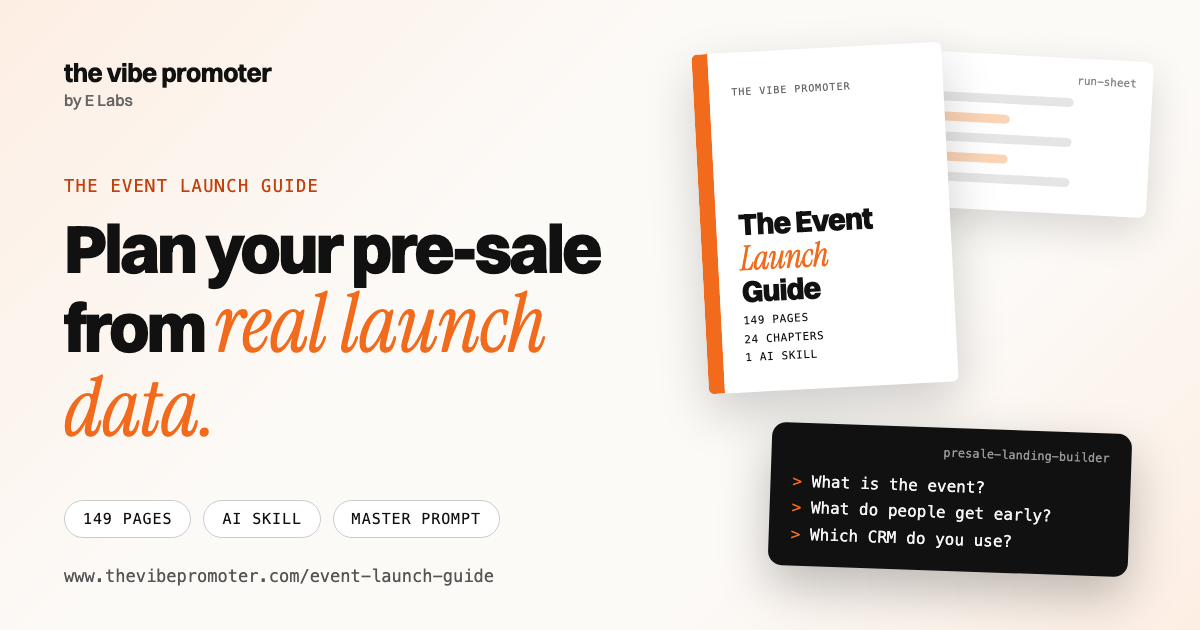
  • Event Launch Guide

    Plan your pre-sale from real E Labs launch data, with an AI skill that builds your pre-sale page.

    £37 one-off

    See Event Launch Guide
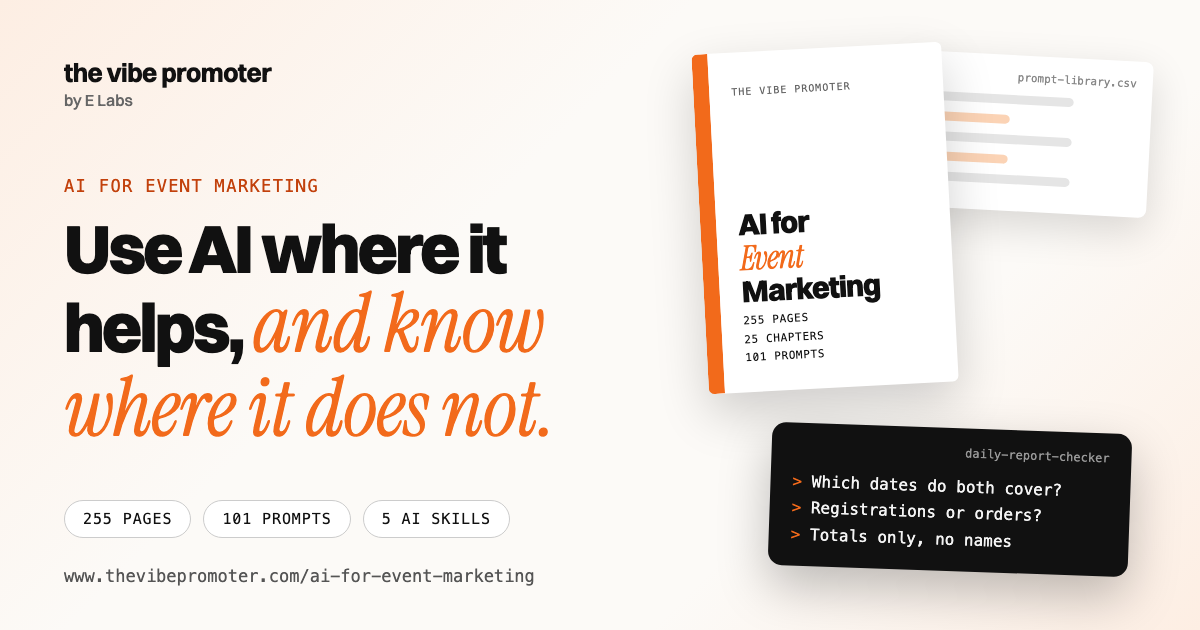
  • AI for Event Marketing

    101 prompts, a 104-tool directory and five AI skills for event promoters, with dated prices and honest limits.

    £59 one-off

    See AI for Event Marketing

Event Marketing Bundle

All three guides for £79. Bought separately they cost £133, so the bundle saves £54 if you want all three.

Separately
£133
Bundle
£79
You save
£54
See the bundle

Before you check out

Want all three guides for £79?

The bundle is the Meta Ads Playbook, the Event Launch Guide and AI for Event Marketing in one payment. You save £54.

  • Event Meta Ads Playbook £37
  • Event Launch Guide £37
  • AI for Event Marketing £59
  • Separately £133
  • Bundle, one payment £79